


Ecuador
Environment’s
Problems

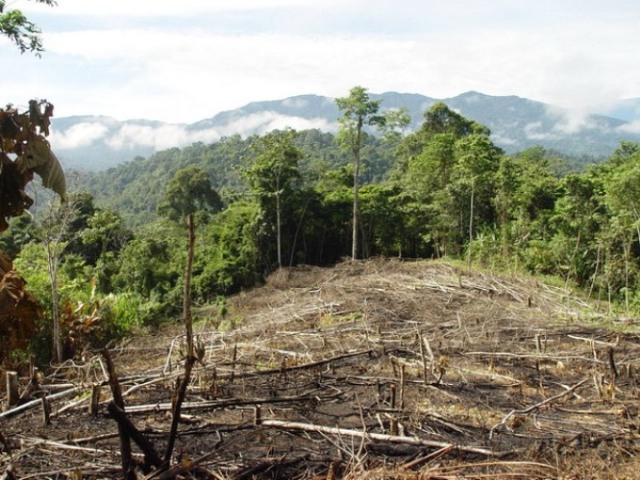
As of 1994, it was estimated that, at current deforestation rates,
coastal forests will be completely eliminated within 15 years and the Amazon
forests will be gone within 40 years. Traditional farming practices have been
blamed for most of these problems, but oil development has also played a role
in the clearing of forests. A program for reforestation and maintenance of
existing forests was initiated in 1979, but only 4,000 hectares (10,000 acres)
were reforested annually during the early 1980s. Ecuador's principal
environmental agency is the Ministry of Natural Resources and Energy. Land
erosion is accelerated by deforestation.
Flooding
and desertification are related problems which have damaged or eliminated
valuable soil, particularly in the western coastal region. Water pollution is a
problem due to the influx of domestic, industrial, and agricultural
contaminants.
 Ecuador's
cities produce about 1.2 million tons of solid waste per year. The nation has
442 cu km of renewable water resources with 82% used for agricultural purposes.
Some 90% of all urban dwellers and 75% of the rural population have access to
pure drinking water.
Ecuador's
cities produce about 1.2 million tons of solid waste per year. The nation has
442 cu km of renewable water resources with 82% used for agricultural purposes.
Some 90% of all urban dwellers and 75% of the rural population have access to
pure drinking water. The expansion of Ecuador's population centers threatens its wildlife. As
of 2001, 28 species of mammals in a total of 302 are currently endangered.
Fifty-three of 1,388 breeding bird species and 12 of 380 reptile species are
also endangered. Of the 19,000–plus plant species in Ecuador, 642 are
threatened with extinction. An extensive wildlife protection system was
established in 1970. As of 2001, 42.6% of Ecuador's total land area was
protected. Endangered species on the Ecuadoran mainland include the tundra
peregrine falcon, yellow-tailed woolly monkey, five species of turtle (green
sea, hawksbill, olive ridley, leatherback, and South American river), and three
species of crocodile (spectacled caiman, black caiman, and American).
The expansion of Ecuador's population centers threatens its wildlife. As
of 2001, 28 species of mammals in a total of 302 are currently endangered.
Fifty-three of 1,388 breeding bird species and 12 of 380 reptile species are
also endangered. Of the 19,000–plus plant species in Ecuador, 642 are
threatened with extinction. An extensive wildlife protection system was
established in 1970. As of 2001, 42.6% of Ecuador's total land area was
protected. Endangered species on the Ecuadoran mainland include the tundra
peregrine falcon, yellow-tailed woolly monkey, five species of turtle (green
sea, hawksbill, olive ridley, leatherback, and South American river), and three
species of crocodile (spectacled caiman, black caiman, and American). Endangered species in the Galápagos Islands include
the dark-rumped petrel, Galápagos dark-rumped petrel (a subspecies), black
petrel, African ass, two species of turtle (green sea and hawksbill), and the
Galápagos giant tortoise and 11 of its subspecies. A subspecies of Galápagos
giant tortoise is extinct, and another may be. Darwin's Galapagos mouse, the
Fernandina Galapagos mouse, Charles Island tortoise, and the Duncan Island
tortoise have become extinct.
Endangered species in the Galápagos Islands include
the dark-rumped petrel, Galápagos dark-rumped petrel (a subspecies), black
petrel, African ass, two species of turtle (green sea and hawksbill), and the
Galápagos giant tortoise and 11 of its subspecies. A subspecies of Galápagos
giant tortoise is extinct, and another may be. Darwin's Galapagos mouse, the
Fernandina Galapagos mouse, Charles Island tortoise, and the Duncan Island
tortoise have become extinct.
Ecuador's natural attractions could lead to increased
tourism, benefiting the economy. However, environmental problems, including
further endangerment of native plants and animals, could be exacerbated without
careful management of the areas attractive to tourists.


Suscribirse a:
Entradas (Atom)